Showing posts with label henry james. Show all posts

Saturday, January 5, 2013

Henry James: The Turn of the Screw, The Aspern Papers, and Two Stories

  • ISBN-13: 9781593080433
  • Publisher: Barnes & Noble
  • Publication date: 8/1/2003
  • Pages: 336
  Rich in his storytelling techniques and psychological insight, Henry James explores human character with an elegant realism. This collection offers four of his most popular shorter works: The Aspern Papers, The Turn of the Screw, "The Jolly Corner," and "The Beast in the Jungle." 
 In The Aspern Papers cultures, generations, and genders clash as a literary historian tries to pry a packet of letters, written by an important American poet, from the woman to whom they were sent many years earlier. The teasingly ambiguous The Turn of the Screw, perhaps the most sophisticated "ghost story" ever written, finds a governess haunted by spirits that seem connected to the children in her care. Are they truly supernatural beings, or projections of her own repressed feelings? As a critique of the popular spiritualism of the 1890's and an exploration of the subjective point of view in narrative, the story remains a fascinating classic of suspense. "The Jolly Corner" and "The Beast in the Jungle" also feature characters who encounter apparitions that may express aspects of their hidden selves. These four texts, published in James's middle and final periods, brilliantly illustrate his thematic concerns and stylistic range.

Whew, what a mouth-full for a title. Well, multiple titles really. This is not the first time I've read James's work, but these short stories are significantly different from The Bostonians, which I read before I went to Korea. (PS - total side note, I just bought my ticket for Japan - egads.) To me, The Bostonians was much less wordy and much more plot driven, but I suppose that makes sense, considering the fact that that was a novel and these are not.
 The first thing I noticed was that James seemed to be saying a whole lot without saying much. Much of the prose was extremely cerebral and rather danced around subjects without explicitly saying what he was talking about. That got a little annoying, and I found myself spacing out a couple of times, and not really missing much. I don't recommend doing that, though, because you might miss something important in the endless prose that might be the key to unlocking the mystery of the plot. What? Yes.
 The first story involved a rather selfish fellow that missed his opportunity at potential happiness. And we see that theme run through all the stories, although the characters manage to save themselves at times and to different degrees. These are The Aspern Papers, Jeffrey Aspern being a fictional poet of little to no importance that has caught the fascination of our protagonist and one of his friends. He goes to Italy to find Aspern's former lover on the assumption that she has papers from Aspern, and he rents out one of her rooms to get closer to her. The adventures ensue from there.
 Following this is The Turn of the Screw, a fairly unusual ghost story. Everything is vague, of course, being James. There is something going on between the children and some ghosts, but who knows what? I certainly don't, even by the end of the story. You have an idea, but I'm not going to tell you so you can revel in the speculation. And there's a lot of speculation.
 The final two stories echo the first two, although to a lesser extent as they are shorter. We have the man facing his own inner demons (i.e. himself) in the form of a ghostly haunting, and a man that is constantly waiting for some big event in his life, to the point where he misses said event. Rather depressing, that.
 James clearly was concerned with a few overriding themes, and I hope for hi sakes he got those issues hashed out.
 Overall: B
 The stories were interesting and had definite ideas to be absorbed, if one is willing to put in the work. If you aren't, though, be advised - this is not super light reading, despite being a collection of short stories.

Friday, February 17, 2012

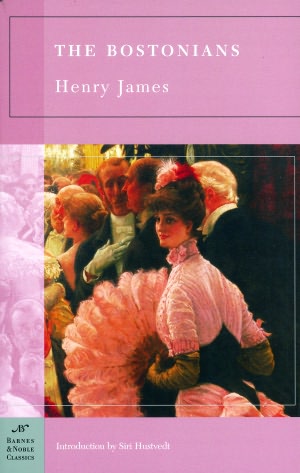
Henry James: The Bostonians

  • ISBN-13: 9781593082970
  • Publisher: Barnes & Noble
  • Publication date: 5/1/2005
  • Pages: 480
Nearly a century before the birth of the contemporary feminist movement, Henry James dealt with its nineteenth-century forerunner in The Bostonians. Mixing acute social observation and psychological analysis with mordant humor, James hangs his story on a unique instance of the traditional romantic triangle. At its apex stands the vibrantly beautiful Verena Tarrant, an intense public speaker who arouses the passions of two very different people. Olive Chancellor, a Boston-bred suffragette, dreams of turning Verena into a fiery campaigner for women’s rights. Basil Ransom, a Mississippi-bred lawyer, dreams of turning her into his wife. As these two struggle for possession of Verena’s soul—and body—their confusions, crises, and conflicts begin almost preternaturally to prefigure today’s sexual politics. In fact, James’s complex portrait of Olive and her ideals, savagely satirical yet sympathetic and so controversial when it first appeared, continues to evoke both anger and admiration. But he treats Verena and Basil with equal complexity, climaxed by the novel’s quietly haunting final sentence.

 I've only ever read one other thing by Henry James, Dubliners, and he's just apparently not a very happy guy. This story was no different. I wasn't anticipating a whole lot of happy, happy, joy, joy, but I was not expecting the level of pissed off I was going to experience by the end of the book.
 The story centered on the feminist Olive Chancellor, who was a satire in and of herself. I'm not sure where James stood on the issue of women's rights, but by what I read I could see him going either way. The character was a passionate, highly intelligent woman, but her downfall was the fact that she spent too much time thinking about the wrongs done to women and fighting the good fight that she often was made to look a fool. Her caricature was almost mocking the women's movement. Then there was Verena who was flighty but good-hearted and was led around by the nose by Olive. She gave herself fully when it was asked of her, but she turned out to be completely useless and not really dedicated, although you couldn't really blame her since she was just sucked into Olive's orbit. Finally, there was Olive's cousin, Basil Ransom. A Mississippian in the years immediately following the Civil War, he's poor and of course, has the gentleman complex. Which is code for saying he acts like an ass for the entire book. He basically decides he's going to seduce Verena away from her activities as a feminist activist because he believes all women are basically useless except in their capacity for loving. Gross. And he somehow convinces Verena and destroys Olive in the process.
 Henry James is always really good at creating ambiguous characters. You hate them for a lot of reasons, but you can also see the reasoning behind a lot of their actions, so you can't entirely justify how much you want to punch them in the face. Verena is so sweet, and you know at the beginning that she doesn't really give a flying rat's ass about the movement and only proclaims she does because Olive makes her believe she does. Basil comes along and we see how irresolute and flaky she is. You want to be sympathetic to Olive, but she's just so damn dramatic about everything you can't stand her. Basil...there were times when I didn't think he was too bad, merely jaded with the world, and especially when he was essentially hunted down by Adeline, but he just trampled all over Olive's and Verena's lives because he could. He was disrespectful and willfully harmful. Plus, everyone knows he's going to treat Verena like crap, even though he's convinced her that her voice and talents are only for him, that she's not meant for public speaking because he doesn't want her "sullied" by it, and that she's going to be happy being dirt poor and basically sitting at home waiting for him.
 As you can see, there wasn't a single character that I liked unreservedly. James isn't a bad writer, he just loves making your emotions fluctuate. I would say this was a great book if I could extract my extreme irritation from the moment Basil hunted Verena down in Cambridge until the end of the book from the equation, but I can't. This book made me actually want to reach in and slap the characters around.
 Which is what it was supposed to do. So for quality of writing:
 Overall: B-
 James can at times be wordy and repetitious, but he's fabulous at characterization, no matter how those characterizations make you feel. The story moves along fairly easily despite his long paragraphs and the development makes sense. I just can't get over the distaste the whole subject left in my mouth which is why my score is lower than it probably should be.