Showing posts with label Charles Dickens. Show all posts

Saturday, August 17, 2013

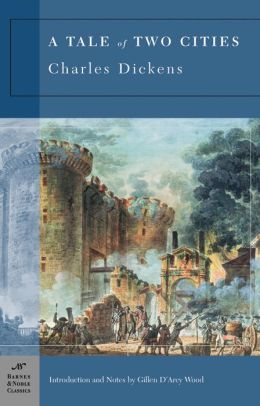
Charles Dickens: A Tale of Two Cities

 "It was the best of times, it was the worst of times..." With these famous words, Charles Dickens plunges the reader into one of history's most explosive eras - the French Revolution. From the storming of the Bastille to the relentless drop of the guillotine, Dickens vividly captures the terror and upheaval of that tumultuous period. At the center is the novel's hero, Sydney Carton, a lazy, alcoholic - but honorable - attorney who is in love with Lucie Manette, a beautiful woman brought up in London. When Lucie marries a man condemned to death for his ties to the aristocratic Evrémonde family, Carton makes the supreme sacrifice on the blood-stained streets of Paris.
 One of Dicken's most exciting novels, A Tale of Two Cities is a stirring classic of love, revenge, and resurrection.
 
This book. Just...ugh. This book
 I suppose I've become jaded, or just have read too many books, but there are very few these days that make me stop and go, "Wow. That was incredible." When I started reading this book, I knew it was going to be well-written, but I didn't think I would like it too much. First of all, it's depressing, we know that from the get-go, and normally books that don't make happy...well, don't make me happy.
 However, this book made me cry, made me hate humanity, and helped me find my faith in them all over again.
 The story centers around the Manette family, Dr. Manette and his daughter, Lucie. They are reunited after nearly twenty years of separation, when the good doctor was wrongly imprisoned in the Bastille. They are at last brought together again by one Mr. Jarvis Lorry. Flash forward to the trial for treason of one Charles Darnay, assisted by one Sydney Carton. Both men in love with Lucie, both looking surprisingly similar; however, one is a French aristocrat who has forsaken his inheritance to make his own way as a tutor in England and the other a wastrel lawyer who has squandered his youth in booze.
 Aside from all these wonderful personal issues, there's a revolution on in France. Ah, yes, that spectacle of liberty, the French Revolution. Started off as a good idea and degenerated into mass violence, betrayal, and madness.
 The novel does a wonderful job of portraying the insanity of the times. I felt genuine terror for what it must have been like to live in those times, never knowing if you were going to be the next one sent to Madame Guillotine for an unknown crime. Along with that terror and disgust of the extravagancies of the uprisen poor, you are also made to feel how very bad their lives actually were, and so you're caught between horror and sympathy. Except for Madame Defarge. She can just go straight to hell and never return.
 Finally, the novel ends in a last act of ultimate sacrifice. A beautiful moment in the face of stark brutality. I don't mind telling you, I cried. It was a beautiful, sad cry.
 Overall: A+
 I am pretty sure that if someone asks, I'm going to say this is my favorite book from here on out. I recommend that everyone read this book. EVERYONE.

Saturday, January 5, 2013

Charles Dickens: A Christmas Carol


  • ISBN-13: 9781593080334
  • Publisher: Barnes & Noble
  • Publication date: 4/1/2004
  • Pages: 304
Generations of readers have been enchanted by Dickens's A Christmas Carol - perhaps the most cheerful ghost story ever. Written in just a few weeks, A Christmas Carol famously recounts the plight of Bob Cratchit, whose family finds joy even in poverty, and the moral regeneration of his miserly boss Ebenezer Scrooge as he is visited by the ghosts of Christmas past, present, and future. 
 From Scrooge's "Bah!" and "Humbug!" to Tiny Tim's "God bless us every one!" A Christmas Carol shines with warmth, decency, kindness, humility, and the values of the holidays. But beneath its sentimental surface, A Christmas Carol offers another of Dickens's sharply critical portraits of a brutal society, and an inspiring celebration of the possibility of spiritual, psychological, and social change. 
 This new volume collects Dickens's three most renowned "Christmas Books," including The Chimes, a New Year's tale and The Cricket on the Hearth, whose eponymous insect chirps amid happiness. 
 
As I really only have The Muppets Christmas Carol as a reference, I have to say - they did a pretty good job of keeping everything accurate. There was never a moment when I said to myself, "Well, that wasn't in the movie."
 But since this is not a movie review, that's all I'll say as far as that goes. I really just wanted to point out that I already knew Scrooge's story fairly well. And it's still one of my favorite Christmas stories. I love the spirit of Christmas present, and I kind of wish he would show up to me some Christmas Eve and take me around and generally have a rockin' good time. Although I would be terribly sad when he eventually grew old as dawn approached. Since everyone pretty much knows A Christmas Carol, I'm pretty much going to leave that one alone. Go read it!
 The second short story in this collection was entitled, "The Chimes." I'm not going to lie to you - I'm not 100% certain what this story was about, for one simple reason - it was a little confusing and also I was extremely tired when I was reading part of it, and was probably fading in and out of consciousness a bit, I blush to say. Essentially, there's a little package-carrier named Trotty that meets the spirits of some bells and they teach him a lesson. That's the major theme in all these stories - spirits teaching lessons. He spends a lot of time thinking about how people are generally bad and especially other poor people, for some reason. The spirits show him that sometimes circumstances lead otherwise good people into desperate situations, and show him a horrible future, pretty just because he was thinking negative thoughts. Of course, he returns home and is grateful for his meager life for the rest of his days.
 Parte trois de this collection is "The Cricket on the Hearth," which is an absolutely lovely story of pure love between two good people and the extent to which love can carry one. That's a lot of love, guys. There's a bitter old man who changes his ways, a sweet little blind girl whose father hides the reality of their bleak life from her unseeing eyes, and a former lover of a young girl who almost destroys a marriage (unintentionally). Sound confusing and like they might not all belong in the same story? I promise it makes total sense and it's a beautiful story. Kind of made me want to have a cricket in my fire place, although I absolutely loathe bugs.
 Overall: A
 Charles Dickens is always a pleasure, but I was particularly pleased with these short stories. They all involved families gathered around a certain communal living space learning to appreciate what they had. And for Christmas, what other lesson is there, really?