Tuesday, May 15, 2012

Charlotte Brontë: Jane Eyre

  • ISBN-13: 9781593081171
  • Publisher: Barnes & Noble
  • Publication date: 2/1/2005
  • Pages: 592
Immediately recognized as a masterpiece when it was first published in 1847, Charlotte Brontë’s Jane Eyre is an extraordinary coming-of-age story featuring one of the most independent and strong-willed female protagonists in all of literature. Poor and plain, Jane Eyre begins life as a lonely orphan in the household of her hateful aunt. Despite the oppression she endures at home, and the later torture of boarding school, Jane manages to emerge with her spirit and integrity unbroken. She becomes a governess at Thornfield Hall, where she finds herself falling in love with her employer—the dark, impassioned Mr. Rochester. But an explosive secret tears apart their relationship, forcing Jane to face poverty and isolation once again.
One of the world’s most beloved novels, Jane Eyre is a startlingly modern blend of passion, romance, mystery, and suspense.

My grandmother has been urging me to read this for a long time, as it's her favorite novel. And that's kind of saying something since my grandmother isn't a big reader of novels outside the trashy-romance genre or mystery genre. I've seen many adaptations of this story, including the most recent Michael Fassbender version (love that man), and so I knew what to expect out of the story. However, it still held some nice surprises.
 For example, I was surprised at the overt mysticism present throughout. In the Bertha Mason storyline and the supposed haunting of the Red Room at Gateshead and at Thornfield, one already had examples of the imagination of Charlotte. However, there were far more references to fairy activity and other mystical (or straight up mythical) goings-on. I was impressed, and seeing as how I might have to write a paper on this book, it caught my eye. There were lots of interesting things going on with the concepts of sanity and what one brings from travel, as well, but that's a subject for a full-blown analysis, not for a measly review. As the blurb on the back of the book says - it was indeed surprisingly modern.
 Jane Eyre was, in my opinion, the most dynamic character in the book although she was often described as plain and quiet. She has developed into one of my favorite literary characters: under her supposed docility lay a fiery spirit that was occasionally aroused. I wish I could be that way - quiet on the outside and powerful on the inside instead of being all-engines on all the time. Most people think Jane is boring, but she's anything but. Mr. Rochester was also far more excitable than I was expecting. For a male in a Victorian novel, he was very arduous. There was a lot more of cuddling going on than is depicted in any film. Witness my shock. Furthermore, St. John Rivers was ridiculously irritating and overbearing. What an ass. The other characters were generally bearable even if they weren't downright likeable. Mostly because any others were barely present.
 Is Jane Eyre the perfect romance as it has been discussed? Not at all. There are several moments that become acutely uncomfortable: the discussion between Jane and Mr. Rochester on the ride back from Milcote when she essentially refused to be his mistress, as she felt he was making her out to be; his rage when she decides to leave him. He was kind of a scary guy, overall. His love for her ends up being genuine, but the language he uses does stray into obsessive territory. That was one of my only complaints about the novel. That, and the occasional long-winded paragraphs about her surroundings. There might be a deeper meaning behind her musings, but for a general, not analytic reading, it was a little much at times.
 Bertha Mason is an interesting personage, and truly terrifying to me. A portrait of madness - when Jane describes her as a hyena with her swollen discolored face, it's...quite unnerving. Most movie versions depict her as perfectly normal looking woman that goes into fits of rage when Rochester is present, but the portrait we are painted goes beyond that. I was disturbed, and I attribute that to the author's mind and writing capability. The plot is so well-known, I don't feel like I need to comment on it at all. If you don't know, then go watch a movie, or better yet - pick up the book.
Overall: A
 It's a classic and it definitely keeps your attention firmly held. There is much more than meets your eye with this piece, and anyone who thinks differently is a fool; yet, it's also the quintessential romance as it has come to be known today. Every woman longs for that man whose willing to cast off society's bonds, who would go to any length to have her - but I think this novel questions, at the same time, if that's really the proper basis for a relationship? That's something to think about. I highly recommend this - cheers from Grandma.
 

Friday, May 11, 2012

Herman Melville: Moby-Dick

  • ISBN-13: 9781411433656
  • Publisher: Barnes & Noble
  • Publication date: 6/1/2009
  • Pages: 752
On a previous voyage, a mysterious white whale had ripped off the leg of a sea captain named Ahab. Now the crew of the Pequod, on a pursuit that features constant adventure and horrendous mishaps, must follow the mad Ahab into the abyss to satisfy his unslakable thirst for vengeance. Narrated by the cunningly observant crew member Ishmael, Moby-Dick is the tale of the hunt for the elusive, omnipotent, and ultimately mystifying white whale - Moby Dick. 
 On its surface, Moby-Dick is a vivid documentary of life aboard a nineteenth-century whaler, a virtual encyclopedia of whales and whaling, replete with facts, legends, and trivia that Melville had gleaned from personal experience and scores of sources. But as the quest for the whale becomes increasingly perilous, the tale works on allegorical levels, likening the whale to human greed, moral consequence, good, evil, and life itself. Who is good? The great white whale who, like Nature, asks nothing but to be left in peace? Or the bold Ahab who, like scientists, explorers, and philosophers, fearlessly probes the mysteries of the universe? Who is evil? The ferocious, man-killing sea monster? Or the revenge-obsessed madman who ignores his own better nature in his quest to kill the beast? 
 Scorned by critics upon its publication, Moby-Dick was publicly derided during its author's lifetime. Yet Melville's masterpiece has outlived its initial misunderstanding to become an American classic of unquestionably epic proportions.

 What to say about a book that has become such a mammoth in the minds of all? It's a gargantuan tale; a whale of a tale, if you will. Okay, I'll stop with the bad puns, but I still stand by the fact that this novel is a hefty read for multiple reasons. Reason 1: sheer size. Melville is fairly prolific as a writer, but his most well-known book is obviously Moby Dick, and it's a long read. Reason 2: it gets tedious. Here was I, never having read or studied the novel, only having seen references to it in film and other novels, thinking that it was a story about a man and a whale and the undying enmity between them. I had enough knowledge of the novel, though, to know that there were chapters of plain whaling information. What I thought was a fictional novel with tangents into whaling factoids actually turned out to be a novel primarily centered on the art and lifestyle of whaling, with a story about a crazy guy chasing a whale thrown in. My mistake. That being said, there is a ridiculous amount of information on that subject. I could not recount a fraction of the information thrown at me. I found myself occasionally doing that most reprehensible of acts - reading a paragraph mindlessly, only to realize at the end that I had no recollection of what I had just read. Unfortunate, but true.
 Because there was hardly a plot to speak of, I'll be equally brief. Ahab had his leg torn off by Moby Dick - he wants revenge. And that's pretty much the point of the novel. Other than go-to whaling manual, there is very little substance to the pot. I would actually say that the novel is more of an observation on the nature of man than it is a novel of fiction.
What to say of characterization? Well, there wasn't much of it. You get to know Ishmael the most, and that's in the initial chapters. More is revealed in his first encounters with Queequeg than at any other time. Even though he's the narrator, he's pretty much invisible to the reader through the rest of the novel. We get to know Queequeg a little, but since it's only through the eyes of Ishmael, it's not that much when all is said and done. We get portraits of the mates and the other harpooners, and a few miscellaneous members of the crew, but these are also brief, barely taking up a chapter (and the chapters are tiny - some don't even cover a page). Finally, we have Ahab. The only thing we really know about him is that he's bat-shit crazy, but he hides it well unless you talk about Moby Dick, then he's all crazy-guns blazing. His first mate Starbuck seems to have the most interaction with his crazy, and you really get to feel for Starbuck. However, the dialogue is often really compounded soliloquies in high-flown language, so you don't feel like you're reading a conversation at all.
 The ending of the novel is sort of anti-climactic. I hope I'm not shocking anyone when I say that both Ahab and the whale die, but the way it is described is not as violent or impressive as one would suppose. The sinking of the ship is far more traumatic, I think, than the culmination and (questionable) success of the hunt. I will give Melville props, though, for language - he is a deep thinker and has quite a few quotable passages. Again, as I've said before, we simply don't use the English language to its full capacity anymore.
 My final comment is that, as a soul-searching project, it has immense power for looking into the human psyche and questioning certain values. Melville is infinitely successful in making you sympathize with the whale and question assumptions. As the summary above states, it is indeed an allegorical tale that, putting the whaling information aside, made me think a little harder about the relationship between man and Nature.
 Overall: B-
Mostly because of disappointed expectations and occasional incomprehensibility. It gets a boost from Melville's writing chops. It had its moments of fun and was definitely interesting, but overall I was looking for more of a work of fiction and less of a whaling how-to.

Thursday, April 12, 2012

Reviews of early books in series.

Oh sad day. I feel like I should mention that many of the books listed have already been read, but they were read so long ago that I don't feel that I can write a good review on them. Therefore, I will have to re-read them, but it may be quite a bit in the future since I need to read the novels that I own in the series that come after those that I have already finished. I just wanted to throw that out there, so that if anyone comes here looking for reviews of the earliest books in a certain series, you may just have to satisfy yourself with the later pieces for a while. The same applies for several of the Barnes and Noble Classics.

Mary Shelley: Frankenstein

  • Paperback: 264 pages
  • Publisher: Oxford University Press, USA; New Ed. / edition (October 15, 2008)
  • Language: English
  • ISBN-13: 978-0199537167
To many readers, who have perhaps known Frankenstein only at second hand, the original may well come as a surprise. When Mary Shelley began it, she was only 18, though she was already Shelley's mistress and Byron's friend. In her preface she explains how she and Shelley spent part of a wet summer with Byron in Switzerland, amusing themselves by reading and writing ghost stories. Her contribution was Frankenstein, a story about a student of natural philosophy who learns the secret of imparting life to a creature constructed from bones he has collected in charnel-houses. The story is not a study of the macabre, as such, but rather a study of how man uses his power, through science, to manipulate and pervert his own destiny, and this makes it a profoundly disturbing book.
 
I didn't end up reading the Barnes and Noble version of this one because I actually ended up reading it for a class and she wanted a specific edition. Also, the one my mother bought for me back home came with a movie and is therefore also a different edition. Just wanted to say that before I started.
 Here is another novel that was completely different from what I was expecting, having seen all the movie adaptations. Well, not all. The image of Boris Karloff is completely off the wall. Kenneth Branaugh's version is actually the closest in my opinion. But I digress. Shelley is terribly wordy and often focuses more on the scenery than is really necessary. I know she was trying to express the emotions which his connection with nature could instill in Victor Frankenstein as a naturalist, yet I still sometimes found my mind wandering during her long paragraphs about the Alps, etc. There was also a lot of anguish with not a lot of action. I'm going to go ahead and chalk that up to writing style. I was also surprised that the monster really never had a name. I had thought that at some point along the line people had just forgotten what it was, but no - it really is just "Frankenstein's Monster." Interesting for analysis, but beside the point for a book review.
 I will say that I did not feel the horror that this novel is supposed to instill until almost the very end when I contemplated the monster's many misdeeds and the terror of anticipation that Frankenstein must be experiencing. Regardless of what kind of creature was committing murder and wreaking havoc, the thought of a murderer constantly present and waiting at your door to kill either you or those you love is...horrible. And the most terrifying part of the whole thing. Unfortunately, Victor spent a lot of time falling into delirious illness, or just expounding upon his misery, so that kind of took away from the terror of it all. It's hard to be scared when you're barely aware.
 The book is definitely an interesting read, and the prose is often beautiful. If one can focus on actually reading the book without letting themselves get too wrapped up in Frankenstein's soliloquies, it's a great read. Several times I found myself wanting to quote Frankenstein on one of his rapturous rants. 
Overall: B
 I felt it could have been a lot better if it had been more to the point in many places. However, if you forget that you're reading a novel for a moment, it makes a great mini-travelogue of the places Shelley and her party visited.

Wednesday, April 11, 2012

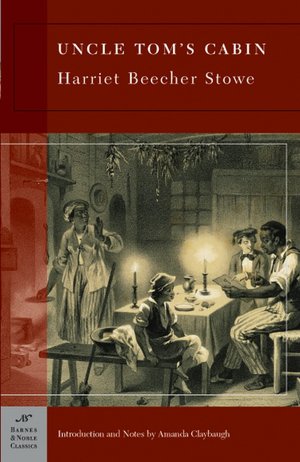
Harriet Beecher Stowe: Uncle Tom's Cabin

  • ISBN-13: 9781593081218
  • Publisher: Barnes & Noble
  • Publication date: 2/1/2005
  • Pages: 496
Nearly every young author dreams of writing a book that will literally change the world. A few have succeeded, and Harriet Beecher Stowe is such a marvel. Although the American anti-slavery movement had existed at least as long as the nation itself, Stowe’s Uncle Tom’s Cabin (1852) galvanized public opinion as nothing had before. The book sold 10,000 copies in its first week and 300,000 in its first year. Its vivid dramatization of slavery’s cruelties so aroused readers that it is said Abraham Lincoln told Stowe her work had been a catalyst for the Civil War.
Today the novel is often labeled condescending, but its characters—Tom, Topsy, Little Eva, Eliza, and the evil Simon Legree—still have the power to move our hearts. Though "Uncle Tom” has become a synonym for a fawning black yes-man, Stowe’s Tom is actually American literature’s first black hero, a man who suffers for refusing to obey his white oppressors. Uncle Tom’s Cabin is a living, relevant story, passionate in its vivid depiction of the cruelest forms of injustice and inhumanity—and the courage it takes to fight against them.

Before I get into this, I have an amusing story regarding this novel. I was reading it while waiting for our flight from Osaka back to Seoul and one of the girls asked me what I was reading. We all started discussing various literary classics, and I recapped the book to someone who didn't know what Uncle Tom's Cabin is about. She then asked me, "Wasn't the author black?" .........Oh honey.
 Anywho, on to the actual review. I will say that I was not expecting to read what I did. Having been educated for years that Stowe's novel was a contributor to the beginning of the Civil War, I was expecting a much more depressing and militant story. What I got was far easier on slavery and far more Christ-minded. I should have expected that part though, knowing that Stowe's brother was an extremely famous preacher. Tom didn't even make an appearance for quite a while and his cabin really had little to nothing to do with the story.
 The writing style was at times eloquent and at times simply wordy. The best characters were highly religiously minded and the relief from their suffering was only their allowance into heaven and the peace that came with their good deeds. At least she was being realistic when depicting the absolute futility of any individual fighting against slavery as an institution, as well as the inability of slaves to alleviate in any part their affliction. The problem that I had, and I'm sure many modern readers have, is her language when referring to the African race. While she was praiseworthy of many of their qualities, she often subscribed to the rhetoric of the day in regards to their inferiority to the white race. In many cases, this was ameliorated by her statement that any creature put in the hell that is slavery would suffer a degradation of character and mental and spiritual acuity, especially with the added neglect of education. However, even these remarks were not enough to remove some of the bitterness of her words. She was a product of her time, though, and the modern reader must take any aspersions in stride. Even with good intent, predominating thought would naturally seep in.
 The characters were fairly well fleshed out. There were a couple that could have been afforded a little more play time, but she had so many characters that it was nigh impossible. The most important characters, though, were either appropriately loveable or appropriately hateable. You genuinely appreciate and feel for Mrs. Shelby and the Sinclares in their kindness toward their slaves. The way in which Eva transforms Topsy and touches all who know her is also truly beautiful. Again, if  you aren't into religion, you'll probably find that most of this book is hard to swallow. But if you can understand that that is the perspective from which it was written and not scoff at the likelihood of such a saintly nine year old, it's a beautiful story. You hate Legree and cheer when George knocks him down.
 The only other problem I had with the novel was the temporary complete disappearance of half of the many characters. Even before we meet Tom, we are acquainted with Eliza's plight, yet after her adventures are assumed to be at an end, it would be lovely to have a little glimpse of her before the final chapter. Also, some of the plot threads' wrap ups seemed highly unrealistic and were, in my opinion, a little too hastily undertaken.
 Overall: B+
 This novel helped spark the liberation of an entire race in North America and is worth the read for that alone. It's a piece of history. That is not to say that it's even close to the best novel to come out of that period, nor does is it perfect. However, it is a wonderful look into the time period and a plea for the betterment of humanity.

Sunday, March 25, 2012

Jane Austen: Mansfield Park


  • ISBN-13: 9781593081546
  • Publisher: Barnes & Noble
  • Publication date: 11/1/2004
  • Pages: 464
From its sharply satiric opening sentence, Mansfield Park dealas with money and marriage, and how strongly they affect each other. Shy, fragile Fanny Price is the consummate "poor relation." Sent to live with her wealthy uncle Thomas, she clashes with his spoiled, selfish daughters and falls in love with his son. Their lives are further complicated by the arrival of a pair of witty, sophisticated Londoners, whose flair for flirtation collides with the quiet, conservative country ways of Mansfield Park.
Written several years after the early manuscripts that eventually became Sense and Sensibility and Pride and Prejudice, Mansfield Park retains Austen’s familiar compassion and humor but offers a far more complex exploration of moral choices and their emotional consequences.

 Oh Jane Austen, how I love thee. Anybody who doesn't agree clearly does not understand good literature.
 Mansfield Park is one of Austen's least read novels, although it has been said that it is probably her deepest novel, and the one that marks her entrance into a more mature style. I don't know about all that, but it definitely lacks some of the hallmarks of the beloved Pride and Prejudice. It is altogether less lighthearted, but there are definite moments of levity that might be easily missed. For example, when Fanny is invited to the Grants for dinner, her spiteful Aunt Norris tells her not to expect the carriage, that she should walk (as her status does not give her the right to the carriage - that is to be reserved for the oh-so-classy daughters of House Bertram). Suddenly, in pops Sir Thomas with the question, "When would Fanny like the carriage?" Oh, Austen perfect timing. Aunt Norris' sputtering is humorous enough, but it Austen's skill with underhanded humor that marks the scene for me.
 Another complaint I've heard is that Fanny is a boring narrator. I don't think so at all. In the third part of the book, whereas in the first two parts we rarely hear Fanny's thoughts or motivations, the whole novel is told from her point of view, and we see that she not only has thoughts and emotions, but that they are just like everyone else's - she just has more moral fiber and correctness to quench certain ill tendencies. The others do not, not even the love-blinded Edmund. Fanny is the only female in the story that one can at all feel for.
 The love story portion is less important, I think, that it is in other Austen novels, but you know that every character gets their just deserts at the end. As Austen herself says, "Let other pens dwell on guilt and misery. I quit such odious subjects as soon as I can, impatient to restore everybody, not greatly in fault themselves, to tolerable comfort, and to have done with all the rest." As one of my professors has said, "If you don't know who's going to end up with who within the first ten chapters, why are you reading Jane Austen?" She's not subtle in her plot, but the point is not her level of predictability. It's how she weaves the character's together and creates living breathing people and lives. Everyone knows an Aunt Norris or a Lady Bertram, a Mary Crawford or a Tom - that's the beauty of Mansfield Park. You get all the stress of hating certain characters without the stressful brand of suspense that is created when you're not sure if the world will be righted in the end. Austen is the Shakespeare of 19th century British literature.
 Overall: A
 Not my favorite Austen, but still Austen, and still wonderful.

Not updating

  I haven't been doing much on the update-y front, but that's not my fault, I promise. I didn't post anything earlier because it's not really pertinent to the purpose of this blog, but I have relocated to Seoul, South Korea for the semester. Naturally, adjusting to a new country and establishing a new routine has left me little time to read, aside from the natural slowing down that being in school causes. I was flying through books for the last two months because I didn't have a job or school to worry about. I was doing my own thing all day, every day. Now I have obligations, both social and educational.
  However, I shall persevere! As a matter of fact, I am currently working my way through Uncle Tom's Cabin, so that will be the next review up. I brought a couple of fairly thick books, that will probably being boring in parts, hoping that what with school work, they will take me the four months that I'm here (have to think about luggage weight, you know). But, if I should finish those, I also have my Nook. Oh yes, and a couple of books that I have to read for a lit class will have upcoming reviews, so I guess I'm wrong when I say that Uncle Tom's Cabin is next.
  Last piece of business: I'm going to add another page for miscellaneous books that I pick up here and there but that don't actually form part of my collection, so that will probably have a large amount of random, organized by title. As always, the authors can be found in the tags.