Thursday, June 26, 2014

David McCullough: Truman

  • ISBN-13: 9780671869205
  • Publisher: Simon & Schuster
  • Publication date: 6/14/1993
  • Pages: 1120
The life of Harry S. Truman is one of the greatest of American stories, filled with vivid characters - Roosevelt, Churchill, Stalin, Eleanor Roosevelt, Bess Wallace Truman, George Marshall, Joe McCarthy, and Dean Acheson - and dramatic events. In this riveting biography, acclaimed historian David McCullough not only captures the man - a more complex, informed, and determined man than ever before imagined - but also the turbulent times in which he rose, boldly, to meet unprecedented challenges, the last president to serve as a living link between the nineteenth and the twentieth centuries. Truman's story spans the raw world of the Missouri frontier, World War I, the powerful Pendergast machine of Kansas City, the legendary Whistle-Stop Campaign of 1948, and the decisions to drop the atomic bomb, confront Stalin at Potsdam, send troops to Korea, and fire General MacArthur. Drawing on newly discovered archival material and extensive interviews with Truman's own family, friends, and Washington colleagues, McCullough tells the deeply moving story of the seemingly ordinary "man from Missouri" who was one of the most courageous presidents in history.

 So my specialty is East Asia and I've studied in both South Korea and Japan. And it's ridiculous that I knew nothing about Truman before reading this book.
 Once again, McCullough has written a book that I just want to go out and yell "READ THIS PLEASE FOR YOUR OWN SAKE." There is so much info packed into this massive tome and it's worth every page. Truman is one of those under-appreciated presidents who gains from history. When he left office, his approval rating was pretty low. Then again, the Korean War was drawing out longer than anyone had anticipated (thanks to MacArthur and several other factors, but I really dislike MacArthur and I wrote two papers about it last year) and America just wanted her boys home. Looking back, history has decided that Truman was one of the best presidents this nation has had. I'm inclined to agree. He's definitely in my top five. He came from small-town nowhere and was associated with machine politics, thought to be a weakling who followed where he was told. He turned out to be a no-nonsense president who, when he had the responsibility thrust upon him by FDR's death, took the reins and did what he believed was right, even if the road was going to be a hard one. Don't even get me started on what a dick FDR was, not talking to his VP at all despite his failing health, thus setting Truman up for failure. Seriously, people. The vice-president becomes president if the president dies, just it's probably a good idea to keep him in the loop. And there's a summary of my rant.
 We're also introduced to Dean Acheson and George Marshall, two of the greatest Secretaries of State that ever lived, in my opinion. There's also a lot of great information on them.
 Anywho. McCullough is always extremely thorough, which I love. He follows Truman from birth to death, and explains the reasoning behind many of Truman's decisions and the difficulties he faced in making those decisions. When it comes down to it, Truman was straight-forward and strong-willed, which I love. Seriously, friends - go read it. It's great history and you will learn so much more than you anticipate.
Overall: A+
 Such good. Much wow.

Christopher Moore: You Suck

  • ISBN-13: 9780060590307
  • Publisher: HarperCollins Publishers
  • Publication date: 1/8/2008
  • Pages: 352
Being undead sucks. Literally.
Just ask C. Thomas Flood. Waking up after a fantastic night unlike anything he's ever experienced, he discovers that his girlfriend, Jody, is a vampire. And surprise! Now he's one, too. For some couples, the whole biting-and-blood thing would have been a deal breaker. But Tommy and Jody are in love, and they vow to work through their issues.
But word has it that the vampire who initially nibbled on Jody wasn't supposed to be recruiting. Even worse, Tommy's erstwhile turkey-bowling pals are out to get him, at the urging of a blue-dyed Las Vegas call girl named (duh) Blue. 
And that really sucks. 

 Oh, Christopher Moore. You brilliant problem child.
 I found this installment of his vampire trilogy to be funnier than the first, for whatever reason. I think it was the more adept incorporation of additional characters. Most of the characters were old acquaintances, and in this volume they were more fleshed out. The Animals took an interesting (re: gross) turn, but they were pulled back on track by the sheer magnitude of their stupidity, so that was a lesson learned. Jody seems to be heading down a path that Tommy had not initially expected, and I foresee that causing problems in the future.
We were introduced to a doofy goth girl who practically worships her vampire overlords, and so she's a weird companion to the Animals. Elijah is back (the vampire that turned Jody) and he has a few other master vampires at his back to help him take care of the mess Jody and Tommy, and by association, he, have unintentionally created. In the end, Jody and Tommy wind up in the same state in which Jody began the novel: as bronzed statues. Spoilers. I won't tell you how they got there, but there is one more novel in this strange series, and we know they're not going to stay that way.
Overall: B+
Weird, funny, and slightly disturbing. Moore's MO. Better than the last one. Still kinda gross.

Jacqueline Carey: Kushiel's Avatar

  • ISBN-13: 9780765347534
  • Publisher: Tom Doherty Associates
  • Publication date: 3/1/2004
  • Format: Mass Market Paperback
  • Pages: 768
The land of Terre d'Ange is a place of unsurpassed beauty and grace. It is said that angels found the land and saw it was good...and the ensuing race that rose from the seed of angels and men live by one simple rule: Love as thou wilt.
Phedre no Delaunay is a woman pricked by Kushiel's Dart, chosen to forever experience pain and pleasure as one. Her path has been strange and dangerous, and through it all the devoted swordsman Joscelin has been at her side. Her very nature is a torturous thing for them both, but he is sworn to her and he has never violated his vow: to protect and serve.
But Phedre's plans put Joscelins pledge to the test, for she has never forgotten her childhood friend Hyacinthe. She has spent ten long years searching for the key to free him from his eternal indenture, a bargain he struck with the gods - to take Phedre's place as a sacrifice and save a nation. Phedre cannot forgive - herself or the gods. She is determined to seize one last hope to redeem her friend, even if it means her death.
The search will bring Phedre and Joscelin across the world, to distant courts where madness reigns and souls are currency, and down a fabled river to a land forgotten by most of the world.
And to a power so mighty that none dare speak its name. 

The cool thing about the word Carey has created is that it is essentially a parallel universe. It is the world as we know it, with different names. Terre d'Ange - France. French for Land of Angels. Caerdicca Unitas - Italy. The land that she goes to seek? The missing tribe of Israel. The One True God? Well, God. Capital G. So, if you know your history, your geography, and your religions, you should be able to tell which one she is talking about and kind of anticipate the culture and what to expect. I think it's cool, although it is, admittedly, a bit of a rip off.
Onto the story: you thought the Phedre/Joscelin drama was done, didn't you? Nope, no, not at all. Joscelin has mostly accepted Phedre's need for pain, but it is taken to a whole new, grotesque level in this book, and he just can't cope. Quite frankly, I probably would have the same problem if I knew what a loved one was going through and had to watch her be abused publicly. So this is perhaps the one time when I totally get where Joscelin is coming from. On the other hand, Phedre's cause is noble and necessary.
We  have two storylines going on here: one, Phedre's quest to save Melisande's son and potential heir to the throne. He's been kidnapped and enslaved in the worst possible place and Phedre has to head into the heart of darkness to rescue him. That accomplished, she continues her second mission, with the help of a hint from Melisande traded for her first mission: to save Hyacinthe by finding the true name of the One God. And that's where all the Christian mythology comes in. Just when you think you've been through enough, just kidding, we have a whole 'nother quest.
Carey is wordy, as always. However, she keeps it interesting. You begin to notice a very distinct writing style and oft-used phrases the further you go on, but it's not so noticeable that it detracts from the story. The ending is happy, and everyone gets what the want. Basically. Which is a real accomplishment in one of this series.
Overall: A-
This book was hella gory and painful. Lots of people dying and being abused in horrible ways. But Phedre gets what she wants, as ever, and shows her wits and ingenuity in the process. Enjoyable as always, if overlong and overwrought at times.

Georgette Heyer: Pistols for Two

  • ISBN-13: 9781402256981
  • Publisher: Sourcebooks, Incorporated
  • Publication date: 2/7/2012
  • Pages: 256
Intrigue, elegance, and glittering romance...
In eleven charming short stories, the Queen of Regency romance presents an exquisite romp through affairs of honor and affairs of the heart. Featuring rakes and rascals, orphans and heirs, beauties and their beaus, the legendary Georgette Heyer's signature wit and inimitable style bring the Regency world dazzlingly alive. 

 Sometimes I forget how much I love Georgette Heyer. And then I read Georgette Heyer, and I remember. This particular work is actually an anthology of short stories. And every one of them is satisfying in its own way. They are, of course, all romantically inclined, some more so than others, and they are all humorous. Not necessarily the laugh-out-loud-and-hold-your-stomach kind of humorous, more along the lines of hijinks and strange personages. Several of the stories are cases of mistaken identity, or simply mistaken assumptions. Some are the exigencies of youth. All are delightful, I assure you.
 Normally, I don't like short stories. At least, romantic short stories. Most of the time, authors are unable to fit a truly engaging love story into so few pages and have you feel satisfied at the end. You're left wanting something more, wandering what happened to the couple when the story ended. Here, you might wonder what happened after, but it doesn't feel like you're missing something. They are fully complete. Love it.
 Overall: A+
 I really love Georgette Heyer. I might have given a slightly higher mark than normal simply because my expectations are lowered for short stories, and these were just so excellent, but I will always give Heyer high points. Definitely go read this. Or read her whole canon. That would be best.

Kim Harrison: Early to Death, Early to Rise

  • ISBN-13: 9780061441691
  • Publisher: HarperCollins Publishers
  • Publication date: 4/26/2011
  • Pages: 256
Madison Avery's dreams of fitting in at school died when she did. Especially since she'd maintained the illusion of a body, dealt with a pesky guardian angel, and oh yeah, brought the reaper who killed her to his untimely end. Not exactly in-crowd material.
Now Madison has learned that she's inherited the job of dark timekeeper and is in charge of angels who protect fate, whatever that means. Never one to abide by the system, Madison forms a group of rogue angels who definitely don't heed the rules of the heavens. But as she grapples with terrifying new powers, Madison may not be prepared for what lies ahead - unless she gets some seriously divine intervention.

If you haven't been following the story up to this point, here's a refresher: Madison - she dead. And she's now in charge of the "Dark" reapers. The big problem with that is that she's not really into doing the job as described. The main conflict of the story is that age old supernatural go-in-hand: Choice. The light reapers and their commander, Ron, foresee a person doing something naughty, one might even say evil, and they decide to preemptively take him out. Madison believes that a person should have the chance to change their minds, to be the better person.
 In this installment, we're dealing with a computer virus and two best friends by the names of Ace and Shoe. I won't let you in on the big twist, but I will tell you one of them is a major douchebag and the other a misguided, but essentially good-hearted, doof.
 Other characters include Madison's frequently exasperated bestie, Barnabas, and her newly acquired reaper, Nakita, who switched to her side in the last book. Also, Paul, Ron's naive new apprentice, who winds up showing some good sense in the end. Three cheers for Paul, keep up the good work on thinking for yourself.
Overall: B+
 It was pretty well written, but there were times when it felt a little rushed and cut off. This is the penultimate book, though, so we have to wait until the next one to see how Madison resolves to resolve her problems.

Emily Dickinson: The Collected Poems of Emily Dickinson

Born in Amherst, Massachusetts in 1830, Dickinson began life as an energetic, outgoing young woman who excelled in her studies. However, in her mid-twenties she began to grow reclusive, and eventually she rarely descended from her room in her father's house. She spent most of her time writing poems, largely without encouragement or real interest from her family and peers. When her poems finally appeared after her death, reader immediately recognized an artist whose immense depth and stylistic complexities would one day make her the most widely recognized female poet to write in the English language.
Dickinson's poetry is remarkable for its tightly controlled emotional and intellectual energy. The longest poem covers less than two pages. .Yet in theme and tone her writing reaches for the sublime as it charts the landscape of the human soul. A true innovator, Dickinson experimented freely with conventional rhythm and meter, and often used dashes, off rhymes, and unusual metaphors - techniques that strongly influenced modern poetry. Dickinson's idiosyncratic style, along with her resonant observations about life and death, love and nature, and solitude and society, have firmly established her as one of America's true poetic geniuses. 

 Oh, friends. What to say about the effervescent Emily Dickinson? She is a huge fan of the dashes and the colons. Some of her poems can seem nigh on unintelligible, unless you spend the time thinking about them. But isn't that the way of most great poets?
 I found that there were many poems that I loved and ended up quoting on one of my other blogs. I quoted fewer than I would have liked, if that tells you anything. If you don't know anything about Emily Dickinson, you should know that she was a depressive soul, and so many of her poems focus on death and the darker aspects of life and love. However, her collection is so wide, one cannot accuse her of being a one trick pony. This particular volume separates the poems into themes, or subject categories if you will, and so if you don't want to read about death, that's okay, head over to the section about nature.
 There isn't much to say about a collection of poems, other than that Emily Dickinson is brilliant, one of the greats. And if you can't understand or appreciate poetry, don't pick this up. But if you can - do.
Overall: A
It's Emily Dickinson. And this edition organizes the poem well with some other nice treats.

Tuesday, January 7, 2014

J.R. Ward: Lover Unleashed

  • ISBN-13: 9780451235114
  • Publisher: Penguin Group (USA)
  • Publication date: 11/1/2011
  • Format: Mass Market Paperback
  • Pages: 576
A fighter by nature, a maverick when it comes to the traditional role of the Chosen female, Payne is cut from the same warrior cloth as her brother. And that's before human surgeon Dr. Manuel Manello gets sucked into her dangerous world. Although he's never believed in things that go bump in the night - like vampires - he's more than willing to be seduced by the powerful female who marks him as her own. But as the two find so much more than an erotic connection, the human and the vampire worlds collide...just as a centuries-old score catches up with Payne and puts both her love and her life in deadly jeopardy.

 This one felt a little rushed, guys. I think this was due in part to two things: one, we've already been introduced to the two main players. Payne and Manny. We know their circumstances. Two, Ward has recently been really into starting romance storylines early, long before she reaches the pairing's main book. For example, we've been dealing with Qhuinn and Blay and their angst for the last few books now. Don't get me wrong - I love Qhuay and their angst. I can't wait to read their book. But a lot of time is spent in the novels leading up to theirs focusing on their issues. Which then takes away from the main pairing.
 In this novel, Wrath accidentally breaks Payne's back in a sparring match. Big whoops. V's mate, Jane, can't do much to help her, so they call in her specialist friend and former potential flame - Dr. Manuel Manello. Kind of a terrible name. He's shocked to find Jane alive (sort of) but as is the way in Ward's wacky world, he sees Payne and it's instant love. Or lust. Or a combination of both. V is naturally over-protective, and he's going through his own crap with Jane and his own mental space as well, which also takes time away from Payne and Manny, but hey. Necessary evil. I won't spoil it for you, but suffice to say everyone gets their pretty happy ending.
 We also have introductions to the Band of Bastards, Xcor's drama, and some murder-y goodness, which I hear is really set up for a Fallen Angels novel. So there's a lot going on.
 Overall: C+
 Quite a few times, the drama felt contrived. I didn't feel enough time was dedicated the ostensible main couple. BUT we did get a lot of new information and set up for future books. And it was, as always, entertaining. Probably my least favorite thus far, though.

Richard Castle: Storm Front


  • ISBN-13: 9781401324902
  • Publisher: Hyperion
  • Publication date: 5/21/2013
  • Pages: 320
From Tokyo, to London, to Johannesburg, high-level bankers are being gruesomely tortured and murdered. The killer, caught in a fleeting glimpse on a surveillance camera, has been described as a psychopath with an eye patch. And that means Gregor Volkov, Derrick Storm's old nemesis, has returned. Desperate to figure out who Volkov is working for and why, the CIA calls on the one man who can match Volkov's strength and cunning - Derrick Storm.
 With the help of a beautiful and mysterious foreign agent - with whom Storm is becoming romantically and professionally entangled - he discovers that Volkov's treachery has embroiled a wealthy hedge-fund manager and a U.S. senator. In a heated race against time, Storm chases Volkov's shadow from Paris, to the lair of a computer genius in Iowa, to the streets of Manhattan, then through a bullet-riddled car chase on the New Jersey Turnpike. In the process, Storm uncovers a plot that could destroy the global economy - unleashing untold chaos - which only he can stop.

 Hello, friends. I have been long away.
 I have a good reason, I swear. I entered grad school in the fall and it's been absolutely insane. I finished one book the first week that school started and haven't had time to read for pleasure since. That is a killer. But I made my fabulous return, so no worries.
 I make my stupendous return with Storm Front by Richard Castle. But wait, isn't Richard Castle a fictional character played on Castle by the effervescent Nathan Fillion? Why, yes, gentle reader, it is. Hyperion has been releasing tie-in books with the TV show written and designed as if they were really written by Castle himself. Having read the first of the Nikki Heat series, I have to say that the writing in the first full novel of the Derrick Storm books (first and possibly only? I don't know) was not quite up to par. It got better the more the story wraps you up, but I noticed two chapters being with "He could only be described as..." which is a) amateur and b) repetitive. And that was upsetting. A few other typos as well which I am apparently becoming hypersensitive to.
 The story was fun and a wild ride, but it wasn't surprising. In fact, halfway through the book you knew who the culprit was and actually...I kind of liked him. Which was the intent, I'm sure. The villain was delusional, which was a delight, but not really. I liked my bad guys to be actually cunning, not just super violent and wildly unrealistic in their expectations. There was a Chinese agent that was absolutely fun as well. All in all, actually, the characters were great, even if only a little background was given. Always humorously delivered, they were fleshed out enough to get an idea of who they were and their role to play, however brief, and to give you a little chuckle.
 Derrick Storm himself was James Bond and Jason Bourne all rolled up into one fantastical package. He could only be described as ruggedly handsome, you see. He had gadgets out the wazoo and the ability to throw a molotov cocktail into a hole in the windshield of a moving vehicle while hanging out of the window of a Jag missing its two back tires. And if that's not a super agent, then I don't know what is. Despite the fact that he's not really an agent.
 It was also fun to see that while the characters in Nikki Heat are the thinly veiled characters from the show, the characters in the Storm novels have the names of the characters in the show but play different roles. If you didn't know it was a tie-in, this would probably smack you in the face with it. Which does create a conundrum since Castle supposedly wrote the Storm novels before he met the NYPD team. Come on, Hyperion, enough with the games. Step up your accuracy game.
 Overall: B
 Major points for being a quick read and a good time, but minus points for being kind of juvenile. It did do a good job of explaining the economic aspect of the world-ending investigation, which I would not have gotten if a five year old couldn't understand it. So good job, "Castle."

Saturday, August 17, 2013

Hideyuki Kikuchi: Mysterious Journey to the North Sea Part 1


  • ISBN-13: 9781595821072
  • Publisher: Dark Horse Comics
  • Publication date: 5/2/2007
  • Series: Vampire Hunter D Series , #7
  • Pages: 280
 A hero, no matter how reluctant, can never refuse the last request of a beautiful girl. 
 When a young woman traveling across the scarred wastelands is murdered over the possession of a strange jewel, she entrusts the gem, with her final breath, to the mysterious Vampire Hunter known as D, and charges him with a desperate mission - to deliver the priceless stone to her sister, far off in a fishing village on the shores of the North Sea.
 D's journey is made ever more perilous by the motley unsavory scoundrels and rogues enlisted by the girl's murderer, who will stop at nothing to claim the jewel. Determined the hunter will not reach his destination, the villains are relentless in their pursuit, one of them harboring a secret, deadly agenda of his own.

 If Dickens in my last review shows the very pinnacle to which humanity can reach, Kikuchi is the master of showing the very depths. Every single novel has a plethora of characters that are the most despicable, low-down, conniving bastards the earth has ever produced. And if that's what you're looking for, this novel doesn't disappoint.
 One of the things that has been bothering me about the progressing adventures of the Vampire Hunter D, is the strangely increasing conversation of the intrepid hero. The author goes on and on and on about the silent and stoic Hunter, but he has been steadily becoming more talkative. If you're going to continue to portray him as the strong silent type, he should remain mostly silent. That's all I'll say about that.
 The adventure in this volume centers around a mysterious pearl that everyone seems to be after without seeming to have any clear idea what it is. The usual number of competitor warriors that think they can defeat D have increased as well. There's at least seven that we know of, and that's just right off the bat. This is a two-parter, so who knows what we'll get next time around.
 In addition, we have a possible Noble on the loose. More remains to be seen on that front, but it does seem like we might get a little more history on D. Exciting.
 And hey, let's give a round of applause for Su-In, the girl he's supposedly helping, who loses her whole family and still manages to keep her head in the game.
 There isn't much more to say since this novel is largely setting up for the next one, when all the mysteries will supposedly be solved. Although I'm sure the mystery of D's origins will be drawn out for the rest of the series so don't hold your breath.
 Oh, and Kikuchi is still creating the most disgusting villains the imagine can come up with. Ew.
 Overall: B+
 Not a whole lot of action, so to speak, and it left more questions than answers. The next one will probably be much better as we can really sink our teeth into the story.

Charles Dickens: A Tale of Two Cities

 "It was the best of times, it was the worst of times..." With these famous words, Charles Dickens plunges the reader into one of history's most explosive eras - the French Revolution. From the storming of the Bastille to the relentless drop of the guillotine, Dickens vividly captures the terror and upheaval of that tumultuous period. At the center is the novel's hero, Sydney Carton, a lazy, alcoholic - but honorable - attorney who is in love with Lucie Manette, a beautiful woman brought up in London. When Lucie marries a man condemned to death for his ties to the aristocratic Evrémonde family, Carton makes the supreme sacrifice on the blood-stained streets of Paris.
 One of Dicken's most exciting novels, A Tale of Two Cities is a stirring classic of love, revenge, and resurrection.
 
This book. Just...ugh. This book
 I suppose I've become jaded, or just have read too many books, but there are very few these days that make me stop and go, "Wow. That was incredible." When I started reading this book, I knew it was going to be well-written, but I didn't think I would like it too much. First of all, it's depressing, we know that from the get-go, and normally books that don't make happy...well, don't make me happy.
 However, this book made me cry, made me hate humanity, and helped me find my faith in them all over again.
 The story centers around the Manette family, Dr. Manette and his daughter, Lucie. They are reunited after nearly twenty years of separation, when the good doctor was wrongly imprisoned in the Bastille. They are at last brought together again by one Mr. Jarvis Lorry. Flash forward to the trial for treason of one Charles Darnay, assisted by one Sydney Carton. Both men in love with Lucie, both looking surprisingly similar; however, one is a French aristocrat who has forsaken his inheritance to make his own way as a tutor in England and the other a wastrel lawyer who has squandered his youth in booze.
 Aside from all these wonderful personal issues, there's a revolution on in France. Ah, yes, that spectacle of liberty, the French Revolution. Started off as a good idea and degenerated into mass violence, betrayal, and madness.
 The novel does a wonderful job of portraying the insanity of the times. I felt genuine terror for what it must have been like to live in those times, never knowing if you were going to be the next one sent to Madame Guillotine for an unknown crime. Along with that terror and disgust of the extravagancies of the uprisen poor, you are also made to feel how very bad their lives actually were, and so you're caught between horror and sympathy. Except for Madame Defarge. She can just go straight to hell and never return.
 Finally, the novel ends in a last act of ultimate sacrifice. A beautiful moment in the face of stark brutality. I don't mind telling you, I cried. It was a beautiful, sad cry.
 Overall: A+
 I am pretty sure that if someone asks, I'm going to say this is my favorite book from here on out. I recommend that everyone read this book. EVERYONE.

Georgette Heyer: Detection Unlimited

 Slumped on a seat under an oak tree is old Sampson Warrenby, with a bullet through his head.
 Everybody in the village is ready to tell Chief Inspector Hemingway who did it. Could the murderer have been the dead man's niece? Or perhaps it was the other town solicitor? The couple at the farm had a guilty secret - what was it? And why is it someone else actually wants to be the prime suspect?
 Add to this the fact that Warrenby was blackmailing someone, and Hemingway has his work cut out for him.
 
 Let's be clear about this title first, because it confused the hell out of me initially: it's called Detection Unlimited because basically every character in the novel is trying to solve the mysterious death of one Mr. Sampson Warrenby. And they all have their theories. Which leads to much hilarity (in my mind at least).
 Mr. Sampson Warrenby, much like a lot of other victims in English murder mysteries, was pretty universally hated, excepting his simpleton niece. Okay, she's not literally a simpleton, but she's just about as annoying as one. She's one of those people that conforms to what society expects and puts a rosy glow on her now-dead uncle. I suppose I have a lot of angst about her since she's obviously still bothering me.
 The mystery, then, lies in who actually had a motive aside from pure dislike, because if we went on that alone, the entire village would be on the suspect list. And they actually are. They lead a merry chase for our hardworking Inspector and his erstwhile companion, who does not have a working appreciation for the cleverness of our little hero.
 Some of the characters are fun and make up for the other busybodies, and the end is a twist that you probably would have seen coming if you'd thought about it enough. The real surprise, though, is more the method of murder than the actual culprit.
 Overall: B
 Not my favorite of Heyer's mysteries, but still a jolly romp nonetheless. And a few of the characters were quite enjoyable and took some of the sting out of the general nosy character of the village.


Thursday, July 18, 2013

Chelsea Handler: My Horizontal Life


  • ISBN-13: 9781455577514
  • Publisher: Grand Central Publishing
  • Publication date: 7/16/2013
  • Pages: 221
In this raucous collection of true-life stories, Chelsea Handler recounts her time spent in the social trenches with that wild, strange, irresistible, and often gratifying beast: the one-night stand.
 You've either done it or know someone who has: the one-night stand, the familiar outcome of a night spent at a bar, sometimes the sole payoff for your friend's irritating wedding, or the only relief from a disastrous vacation. Often embarrassing and uncomfortable, occasionally outlandish, but most times just a necessary and irresistible evil, the one-night stand is a social rite as old as sex itself and as common as a bar stool.
 Enter Chelsea Handler. Gorgeous, sharp, and anything but shy, Chelsea loves men and lots of them. My Horizontal Life chronicles her romp through the different bedrooms of a variety of suitors, a no-holds-barred account of what can happen between a man and a sometimes very intoxicated, outgoing woman during one night of passion. From her short fling with a Vegas stripper to her even shorter dalliance with a well-endowed little person, from her uncomfortable tryst with a cruise ship performer to her misguided rebound with a man who likes to play leather dress-up, Chelsea recalls the highs and lows of her one-night stands with hilarious honesty.
 Encouraged by her motley collection of friends (aka: her partners in crime) but challenged by her family members (who at times find themselves a surprise part of the encounter), Chelsea hits bottom and bounces back, unafraid to share the gritty details. My Horizontal Life is one guilty pleasure you won't be ashamed to talk about in the morning.


 Before I get into this, I just want to say that I think Chelsea Handler is hilarious. She's one of my favorite comediennes. HOWEVER. This book is way more information than I really wanted. About a lot of things. Mainly, her vagina.
 The book started off hilarious, but somewhere in the middle it lost me. I personally am not a promiscuous or adventurous person. Far from it, in fact. I would say somewhat reserved even. But I acknowledge that other people have fewer scruples and repressed guilt issues than I do, and I don't begrudge them their sexual misadventures. But Chelsea, according to this, takes it to another level. Some of the stories are suitable mortifying and riotous. Some, however, are lessons in what not to do - ever.
 I was continually impressed, however, with Chelsea's stunning ability to act in the moment and improve her way out of awkward situations. I wish I had that presence of mind. Most of the time I just loose my tongue, unless I've already thought up a pliable lie and then BAM Oscar-winning performance. Swear to God.
 I don't feel like there is very much to say about an autobiography aside from one's personal reactions. It is, after all, someone else's life story, not fiction, and there isn't much to say about plot holes or character development. I did appreciate, though, that we visibly moved forward in Chelsea's life, and that there was a life lesson to take away at the end. She showed a level of maturity and self-realization that she had not previously displayed throughout the whole of the book, and I am a huge sucker for development. Four for you, Chelsea.
 Overall: B
 Not super impressed with her sexcapades, but props for the amounts of laugh-out-loud material. The stories, while some required mind-bleach, were told brilliantly.

Oscar Wilde: The Collected Oscar Wilde


A renowned eccentric, dandy, and man-about-town, Oscar Wilde was foremost a dazzling wit and dramatic genius whose plays, poems, essays, and fiction contain some of the most frequently quoted quips and passages in the English language. 
 This volume features a wide selection of Wilde's literary output, including the comic masterpiece The Importance of Being Earnest, an immensely popular play filled with satiric epigrams that mercilessly expose Victorian hypocrisy; The Portrait of Mr. W. H., a story proposing that Shakespeare's sonnets were inspired by the poet's love for a young man; The House of Pomegranates, the author's collection of fairy tales; lectures Wilde delivered, first in the United States, where he exhorted his audiences to love beauty and art, and then in England, where he presented his impressions of America; his two major literary-theoretical works, "The Decay of Lying" and "The Critic as Artist"; and a selection of verse, including his great poem The Ballad of Reading Goal, in which Wilde famously declared that "each man kills the thing he loves."
 A testament to Wilde's incredible versatility, this collection displays his legendary wit, brilliant use of language, and penetrating insight into the human condition.
 
So Oscar Wilde is pretty much one of my favorite playwrights of all time. I mean, The Importance of Being Earnest? Come on. One of the most hilarious plays of all time. He was also incredibly intelligent, albeit Socialist. And did I mention that he went to jail for being gay? So yeah, A+ life story.
 In Barnes and Nobles' classics edition, they compile a rather stellar display of his many works. Starting off with short stories, they segue into poetry, articles, essays, and finally end with a three act version of Earnest. Therefore, you get a great sampling of the many interests of Wilde and the way in which his brain worked.
 Personally, a lot of what he said really resonated with me and what I feel the political and media situation of today. His essay, Critic as Artist, screamed at me about the faultiness of the media. He also spent a lot of time in The Truth of Masks talking about the importance of period-accurate costuming in drama, referring to Shakespeare's copious notes to his performances, making it easy for reproductions to portray the characters as Shakespeare originally intended.
 Wilde, aside from having a great intellectual mind, was also highly creative and wrote beautifully. The collection starts off with eight short stories, my favorite of which was Lord Arthur Savile's Crime, which is written with the same humor and attention to the ridiculous as Earnest. Which is probably why I was so amused. I cracked up laughing just telling the story to my uncle after I read it.
 Overall: A
 Wilde can sometimes become dry and pedantic, which makes his essays occasionally difficult to muddle through. But this is still a great collection, and I highly recommend it. WARNING The House of Pomegranates is actually not included in this volume, not sure why it's in the blurb.

Janet Evanovich: Wicked Appetite


  • Mass Market Paperback: 352 pages
  • Publisher: St. Martin's Paperbacks; First Edition edition (August 16, 2011)
  • Language: English
  • ISBN-13: 978-0312383350
Lizzy Tucker has inherited a historic house in Marblehead, Massachusetts, taken a new job as pastry chef for Dazzle's Bakery in Salem, and set her sights on a comfortable future. The comfortable future and any hope for normalcy evaporates when dark-haired, dark-hearted Gerwulf Grimoire and his nemesis, a blond beach bum named Diesel, enter Dazzle's and change Lizzy's life forever.
 Grimoire has set his sights on the Stones of SALIGIA, rumored to have found their way to Salem. These seven stones, each representing one of the seven deadly sins, can bestow frightening powers upon its owner. Powers that would be dangerous in Grimoire's hands...
 Diesel is a man with a mission: to stop Grimoire at all costs. In order t do so he'll need to convince the baker she alone has the ability to keep Grimoire from the stones. Once Lizzy and Diesel become a team, Diesel will have to guard Lizzy's body...day and night.
 The Seven Deadly Sins pretty much cover everything that's wicked. Diesel thinks they also pretty much cover everything that's fun. And Lizzy thinks Diesel and The Sins cover everything her mother warned her about...
 
 I sometimes forget how short Evanovich novels generally are these days. No less funny, no less ridiculous, no less Evanovich-y, but short.
 In Wicked Appetite, the first of the Lizzy and Diesel series, Lizzy is initiated into the world of the Unmentionables. And no, I'm not talking about your grandmother's underwear. I'm thinking there are going to be at least seven in the series, because I am a fan of complete-ness (not completion, mind you) and I swear to God if she doesn't hit all seven deadly sins...there will be hell to pay. See what I did there?
 Diesel, who we know from the between-the-numbers holiday books of Evanovich's Stephanie Plum series, is hunting Gerwulf Grimoire, his cousin, who is looking for the stones of the seven sins in order to rule the world. According to Diesel, of course. Lizzy seems to be the only person around who can help him, having the Unmentionable ability of being able to sense Unmentionable objects. Sound convoluted? It's not really. She makes Unmentionable cupcakes.
 Evanovich's humor shines through, as usual, in the completely unrealistic and ridiculous antics her characters get up to and the completely bemused, I-give-up-let's-roll-with-it attitude with which they confront their increasingly complicated lives. Her usual animal sidekicks are present in the forms of the monkey Carl and Cat, the one-eyed guardian of Lizzy's inherited home.
 As far as characterization goes, Evanovich has started to rely on tropes. Her girls are good-natured, awkward ladies confronted with strange circumstances who have breakdowns every once in a while that are easily tempered with baked goods. The men are sweet but occasionally lascivious. There's the crazy sidekick who is also good-natured but constantly causing problems. It's a formula that works, but it's a formula nonetheless.
 Overall: B
 There wasn't much punch to this novel, but it was funny and enjoyable. Hopefully the plot is cleared up a little more in future books. The characters aren't even really certain what they're looking for most of the time.

Wednesday, July 17, 2013

Diana Gabaldon: Dragonfly in Amber


  • Mass Market Paperback: 976 pages
  • Publisher: Dell; Reprint edition (November 2, 1993)
  • Language: English
  • ISBN-13: 978-0440215622
For twenty years Claire Randall has kept her secrets. But now she is returning with her grown daughter to Scotland's majestic mist-shrouded hills. Here Claire plans to reveal a truth as stunning as the events that gave it birth: about the mystery of an ancient circle of standing stones...about a love that transcends the boundaries of time...and about James Fraser, a Scottish warrior whose gallantry once drew a young Claire from the security of her century to the dangers of his...
 Now a legacy of blood and desire will test her beautiful copper-haired daughter, Brianna, as Claire's spellbinding journey of self-discovery continues in the intrigue-ridden Paris court of Charles Stuart...in a race to thwart a doomed Highlands uprising...and in a desperate flight to save both the child and the man she loves...

She even used the book title twice in the book (at least). Label me impressed.
 This book picks up right where the last one left off, once you get into the second part. First, though, you have to suffer through a few chapters of intense confusion. Claire is back in the present for some reason that we cannot at that point fathom, and she's looking for information on the men who died at Culloden, the very battle she was trying to prevent when last we left her. So immediately we know she failed. The question then becomes how and why.
 From there on it's a fairly romping adventure through France and back to Scotland with murder, scandal, and, of course, political intrigue. Jamie and Claire are trying to sabotage James and his Charles' attempt to initiate a revolution in England to gain the throne from George, but they have to appear to be Jacobites in order to farm their information without suspicion. This leads to some pretty uncomfortable circumstances as can be imagined.
 The one complaint I would have to lodge is a pacing issue. There are quite a few times when I was reading and I wondered why I was reading about some minute moment in Claire Randall's life. The book is already pretty massive and packed with action, so I could have done without some example of random domesticity. At the end, when you think it might be time to be close to over, you're wrong. The book continues far beyond what is reasonable. It seemed to be wondering in the last few chapters, skipping huge chunks of time. It was almost as if she was trying to cram everything into the last few sections and it came out kind of a trainwreck, I felt. Finally, the giant "plot twist" at the end seemed random and irrelevant when it came down to it. You didn't see it coming because a) it was almost forgotten and b) there was absolutely no hint of it. Rule #1 of writing a good mystery - don't pull your suspects or your motives completely out of your ass.
 SPOILER ALERT SPOILER SPOILER DO NOT READ IF YOU DON'T WANT A SPOILER
Aside from the pacing issues, the characterization was great. I especially enjoyed the development of Jack Randall (yes, he shows back up, are we really all surprised?). She did an excellent job of compromising what you thought of him and letting you see that maybe he had a softer side after all. And I thought Jamie learned a huge lesson in the last scene with Randall as well.
 Overall: B-
 The pacing issues really did bother me.


Friday, June 21, 2013

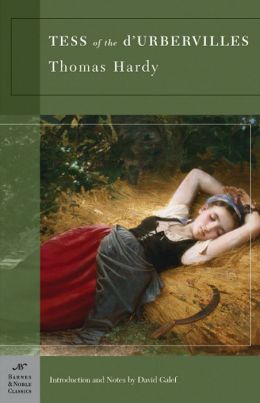
Thomas Hardy: Tess of the d'Urbervilles

  • ISBN-13: 9781593082284
  • Publisher: Barnes & Noble
  • Publication date: 6/5/2005
  • Pages: 544
Highly controversial because of its frank look at the sexual hypocrisy of Victorian society, Thomas Hardy's Tess of the d'Urbervilles was nonetheless a great commercial success when it appeared in 1891. It is now considered one of the finest novels in English.
 Using richly poetic language to frame a shattering narrative of love, seduction, betrayal, and murder, Hardy tells the story of Tess Durbeyfield, a beautiful young woman living with her impoverished family in Hardy's fictionalized Wessex, a pastoral community in southwestern England. After the family learns of their connection to the wealthy d'Urbervilles, they send Tess to claim a portion of their fortune. She meets and is seduced by the dissolute Alec d'Urberville and secretly bears a child, Sorrow, who dies in infancy. Angel Clare, a very different man, seems to offer Tess love and salvation, but he rejects her - on their wedding night - after learning of her past. Emotionally bereft, financially impoverished, and victimized by the self-righteous rigidity of English social morality, Tess escapes from her vise of passion through a horrible, desperate act. 
 With its compassionate portrait of a young rural woman, powerful criticism of social convention, and disarming consideration of the role of destiny in human life, Tess of the d'Urbervilles is one of the most moving and memorable of Hardy's novels.
 
 This book should be called Tess of the D'UrberVILES.
 Aha, see what I did there?
 Joking aside, there is nothing funny about this book. It is literally a sad fest from beginning to end. Now that you have that out of the way though, and you know that you will derive no happiness from reading this book, you can sit back and enjoy it. Because it really is beautifully written, and when you're reading it you forget a little bit about how miserable it all is.
 Really, this book is one thumper of a social commentary. The subtitle, not presented in this addition, is actually A Pure Woman Faithfully Presented. You would laugh if you knew the story beforehand and read that subtitle. Thanks to me, you can enjoy the inside joke now. Tess is a poor "farm girl," despite the fact that what I can tell, her father and mother do little to no work. She's beautiful and sweet and pure, until Alec D'Urberville comes into her path. A kindly clergyman alerts her father to his ancestry, coming from the illustrious D'Urberville line going back to William the Conqueror, and so her parents send her off to claim kin with the D'Urberville family living up the road. Except they bought into the name, don't actually come from the line. And Alec is a horny philanderer.
 All of this results in the destruction of Tess' life. It's not her fault - and that's the key. She might be blamed for being weak-willed and succumbing to her parents' wishes too easily, but other than that, her plight is the plight of many women before her and probably many after. What Hardy points out is the hypocrisy of society in blaming and punishing the woman for actions outside her control. Even when she attempts to distance herself from the circumstances of her disgrace, she is still held accountable by those who purport to be more understanding. She can't escape and her weakness leads her into more problems, until, finally, there is no way out.
 Well, that's about as best as I can describe it without giving you the entire story. Although, if you're really, super desperate to know the full tale, Wikipedia is your friend. Now let's talk about some characters.
 Alec is a giant douchenozzle to end all douchenozzles. He's manipulative in the extreme. Angel Clare, the other purported protagonist of the tale, is a sweetheart with some serious identity issues. He's parted from his clergyman father because he disagrees with his extremist religious views, but he still can't escape his roots. It's a common problem. No matter how old you get, it's hard to break old habits and ways of thought. Another lesson to take away.
 Overall: B+
 I enjoyed it, mostly because I didn't expect a lot of happiness to come out of it. There were some dry bits, but even in the amidst of wordy paragraphs celebrating odes to the beauty of the countryside, Hardy's craft is obvious. He was a great writer. So there you have it. Don't read this if you want to be happy and have faith in humanity after.

Saturday, June 8, 2013

Melissa Marr: Radiant Shadows

  • Paperback: 368 pages
  • Publisher: HarperCollins; Reprint edition (February 22, 2011)
  • Language: English
  • ISBN-13: 978-0061659249
Hunger for nourishment. Hunger for touch. Hunger to belong.
Half-human and half-faery, Ani is driven by her hungers. Those same cravings also attract powerful enemies and uncertain allies - including Devlin, the assassin who is brother to the faeries' High Queen. Ani and Devlin are drawn together, but as they grow closer, a larger threat imperils the whole of Faerie. Will saving the Faery realm mean losing each other?
 Alluring romance, heart-stopping danger, and sinister intrigue combine in the penultimate volume of Melissa Marr's New York Times bestselling Wicked Lovely series.

AH THIS TITLE MAKES SO MUCH SENSE NOW. It's really the only one, other than Ink Exchange, but yeah. Side note of excitement for sudden and blinding comprehension.
 With this installment, Melissa Marr draws one step closer to the final novel in her faery series. She keeps building on her world, which is nice, but on the other hand, I sometimes lose track of who's who. There are just so many characters running around, and shifting of allegiances, that I find myself having to go back every once in a while and refresh on what happened previously. That gets a little annoying, but I'll make the sacrifice for such a good series.
 So, in Radiant Shadows, Sorcha's losing her damn mind, the Summer Court and the Winter Court barely make appearances other than to say that hey, nothing's changed, and the Dark Court is still confusing as hell. Mostly, Irial and Niall confuse me. I have no idea why Niall angsting so hard, but he is, and Irial is still largely awesome, so there are, effectively two Dark Kings. Ish.
 The focus of this novel, one of the so-called "in between" novels, is the halfling Ani, who was introduced in the first novel, I believe. She's part Hound and is incredibly antsy to be accepted. Except that's difficult because she's...special. Enter Devlin, the High Queen's Bloody Hand, re: assassin, who was supposed to kill Ani once upon a time, but clearly didn't. Chaos ensues. Doesn't it always? This time, though, I mean literally: Bananach, War and Disorder embodied, is on the warpath and trying to stir up trouble.
 Marr is building on what she's already created, so there's not a lot of character development going on. It's kind of just getting to know already semi-familiar characters. Unless she throws in a new player, which she does (cough RAE cough DREAMWALKER WHO THE HELL ARE YOU WHAT IS GOING ON cough). Further, the plot is interesting and sufficiently twisty, although she could stand with a little less mystery and a little more exposition. For example, can we have a more clear statement regarding where Ani's wolves come from? What's up with Seth? And also are we just dropping the subject of her supposedly precious blood? (I'm sure that will be answered in the last novel, though.)
 Overall: B+
 It was not my favorite of her novels, and I'm getting a little tired of being denied knowledge gratification until the last few chapters of the novel. But it was still good and it definitely built up the suspense for the next, and last, installment.
So apparently Russia loves me.

Tuesday, May 28, 2013

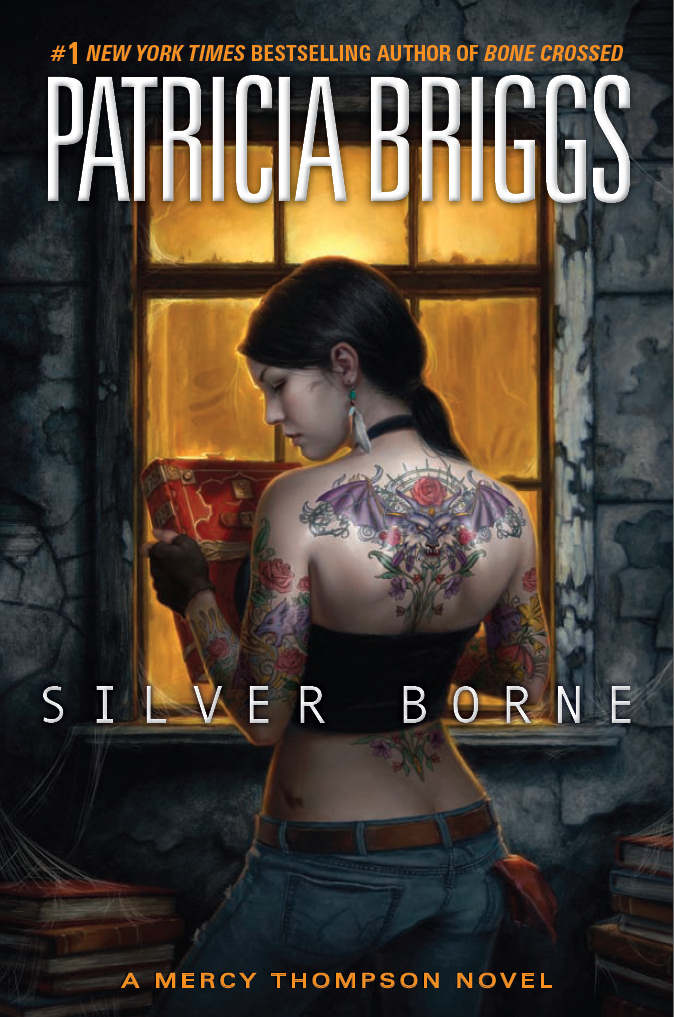
Patricia Briggs: Silver Borne


  • ISBN-13: 9780441019960
  • Publisher: Penguin Group (USA)
  • Publication date: 1/25/2011
  • Series: Mercy Thompson Series , #5
  • Format: Mass Market Paperback
  • Pages: 304
 When Mercy Thompson, mechanic and shape-shifter, attempts to return a powerful fae book she previously borrowed in an act of desperation, she finds the bookstore locked up and closed down. 
 It seems the book contains secrets - and the fae will do just about anything to keep it out of the wrong hands. And if that doesn't take enough of Mercy's attention, her friend Samuel is struggling with his wolf side - leaving Mercy to cover for him lest his own father declare Samuel's life forfeit. 
 All in all, Mercy has had better days. And if she isn't careful, she may not have many more... 
 Mercy Thompson is, hands down, one of my favorite heroines of all time. OF ALL TIME. She's badass, she's brave, she's independent. But in this book she learns something else that we haven't really seen from her yet: she learns that it's okay to lean on someone else and be the weak one for a while. Having spent the last four months immersed in Supernatural, I find this message particularly meaningful after watching Dean Winchester struggle to take all the blame and responsibility of the world on his own shoulders and sacrifice himself for others time and again. OKAY that went where it wasn't meant to go, but the point is, I appreciated Mercy's development all the more because of my Supernatural feels.
 In this installment of her saga, Mercy's dealing with pack and fae bullshit. The pack, being a bunch of mostly old-fashioned dogs, essentially, are having a little trouble accepting a coyote shifter as their Alpha's mate. Since Adam and Mercy are still on precarious ground after her rape of two novels ago, they haven't really taken the time to figure out the dynamics of the magical pack bond that Mercy now has to deal with. Prime time for messing with Mercy's head. Throw in Samuel's mental breakdown (he's very old and very lonely) and you have a recipe for oh-man. And a major plot twist for our favorite white wolf toward the end.
 Also, the fae are after her, again. Although it's not the Gray Lords and it's not a group of fae so much as it's one fae in particular throwing a wretch of a wrench into her life, so that's a plus. Zee's son, Tad, asks Mercy to check in on a mutual friend, and hijinks naturally ensue.
 As I've already kind of intimated, the developing relationship between Mercy and Adam is my favorite part of this novel. Every time something happens to Mercy, Adam climbs the walls and has a freak out, and I, damsel at heart that I am, love to see a man lose his cool when his love is in danger. And since he's a wolf, that means a whole lot more. He has a few this novel, mostly because of the issues with the pack bond, but Mercy handles them supremely and actually talks it out with him, which is a major step in any relationship. So rah-rah on that front. AND BRAN AND CHARLES. They show up briefly and basically any chance to see Bran has me cheering from the rafters.
 Overall: A
 It wasn't as completely action packed as the other novels, but it definitely kept me on the edge of my seat with a ton of "will-he-or-won't-he" situations. Or she. There were a lot. The mystery also had an interesting twist.

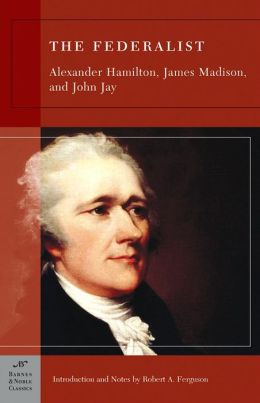
Alexander Hamilton, John Jay, James Madison: The Federalist

A classic of American political thought, The Federalist is a series of eighty-five essays by three authors - Alexander Hamilton, James Madison, and John Jay - written to curry support for the proposed new Constitution of the United States, a document that many considered too radical. Most of the "papers" were published in periodicals as the vote drew near. Without the support of these powerfully persuasive essays, the Constitution most likely would not have been ratified and the United States might not have survived as a nation.
 Beginning with an assault upon the country's first constitution, the Articles of Confederation, the authors of The Federalist present a masterly defense of the new system. They comment brilliantly on the proper size and scope of government, taxation, impeachment, and many other issues of the day.
 Written in haste and during a time of great crisis in the new American government, the articles were not expected to achieve immortality. Today, however, many historians consider The Federalist as the third most important political document in American history, just behind the Declaration of Independence and the Constitution itself. It has become the benchmark of American political philosophy, and the best explanation of what the Founding Fathers were trying to achieve.

 For those of us unaware of United States history, let me sketch an incredibly rough portrait: following the Revolutionary War, it became increasingly clear that the Articles of Confederation, a proxy constitution thrown together to tie all the different states into an alliance and ensure some form of unity, would not suffice to maintain a stable government among the states. So a convention was called to write a constitution for the new-born country. There were many issues, naturally, but the biggest and most general was whether or not the federal (central) government would be strong or would be fairly weak. This resulted in a divide between the federalists, who wanted a strong central government capable of occasionally overriding states' laws, and the states-rights group, who wanted the power to rest in each individual state - which, if you haven't noticed, isn't really a united anything as much as a group of people who agree with each other, sometimes.
 Into the fray jump three of the times most influential authors/statesmen: Alexander Hamilton, James Madison, and John Jay. Coming solidly down on the side of the federalists, and defending the Constitution that was at that time being written, reviewed, and voted on, these three published a series of papers under the collective name of "Publius" addressing each of the contentions of their opponents.
  First, I would like to say that I love these three men. Alexander Hamilton, while a conniving, philandering ass at times, was brilliant. John Jay and James Madison, also, were brilliant. So this is a collection of gorgeous minds systematically arguing their point.
 Who would read this collection of papers in the modern day? Very few, I imagine. Still, I think everyone would benefit from reading them, especially in the times in which we live. We need a reminder of the men who fought for our rights in the first place, why they fought, and what they were fighting for. We need a reminder of what the Constitution was originally meant to be and how far we have strayed from the ideals of the men who founded this country. Do I think they had it all right? Absolutely not. They weren't perfect, or seers of the future. They were men of their times. But I think the lessons they have to teach ring true even today, if we could just be bothered to pay attention to them.
 Overall: A
 There wasn't a ton of legal-ese or specialized jargon despite the positions these men occupied. Of course. They wanted to reach as broad an audience as possible. The headings are easy to follow, their arguments make sense and every once in a while they, especially Alexander Hamilton, can be downright sassypants, and I love that.
 SIDE NOTE: Coincidentally, as I was reading this while in Japan, one of my Japanese friends had to read excerpts from The Federalist for her English class. Haha, what?